For many, calibration feels like a necessary evil and a recurring cost – a certificate attached to your equipment to show compliance with customer requirements, regulations, internal quality systems and planned maintenance. But calibration is more than documentation.
Calibration often ends up as something that “just needs to be done”, partly because the requirements for how instruments should be calibrated are not always clearly defined. Calibrating against the manufacturer’s specification is perfectly valid, but it can sometimes lead to over-calibration and unnecessary cost. So what does calibration really mean for you – and what should you consider?
Key considerations
Understand your actual needs: If the real requirements for your measuring instruments are unclear, you risk paying for calibration intervals, documentation and performance levels you do not truly need – or missing what you actually do need.
Assess equipment capabilities: Instruments are often selected based on legacy choices, theoretical calculations, or what was available “off the shelf”. Reviewing whether the equipment is suitable for its intended use is essential.
Consider installation and operating conditions: Are there factors in daily use that may influence measurement results and should be reflected in the calibration approach?
On-site vs external calibration: Does the instrument need to be calibrated in place, or can it be removed and calibrated in a workshop or accredited laboratory?
Set realistic expectations: What performance is practically achievable in real conditions? At a minimum, calibration should confirm that the instrument meets the specified overall performance.
Calibration as a periodic functional check
Calibration provides ongoing verification that your measurements remain reliable over time. It may not create profit directly, but without reference checks you cannot be confident in the true performance of your instruments.
The risks of ignoring calibration
When an instrument used in regulated processes or billing systems no longer performs within specification, it can lead to:
Unnecessary raw material use
Increased environmental impact and energy waste
Quality deviations and rework
Serious financial or compliance consequences
The bottom line
It is always worth assessing how critical an instrument is to your process. Calibration is not just a cost – it is an investment in reliability and risk reduction. The question is not whether calibration is good business, but whether you can afford to operate without it.
Definition of Calibration*: A set of operations that, under specified conditions, establishes the relationship between the values indicated by a measuring instrument or measuring system, or the values represented by a material measurement or reference material, and the corresponding values realized by standards. It is important to understand that calibration does not include adjustment.
*VIM (Vocabulary of Basic and General Terms in Metrology)
A Simplified Explanation
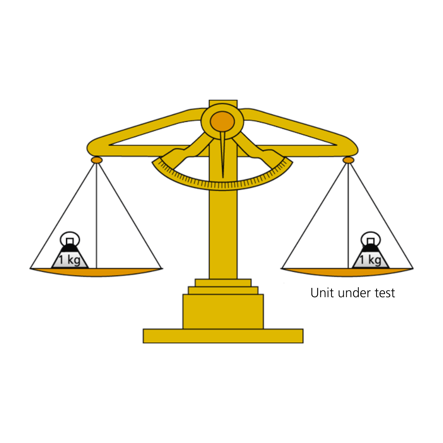
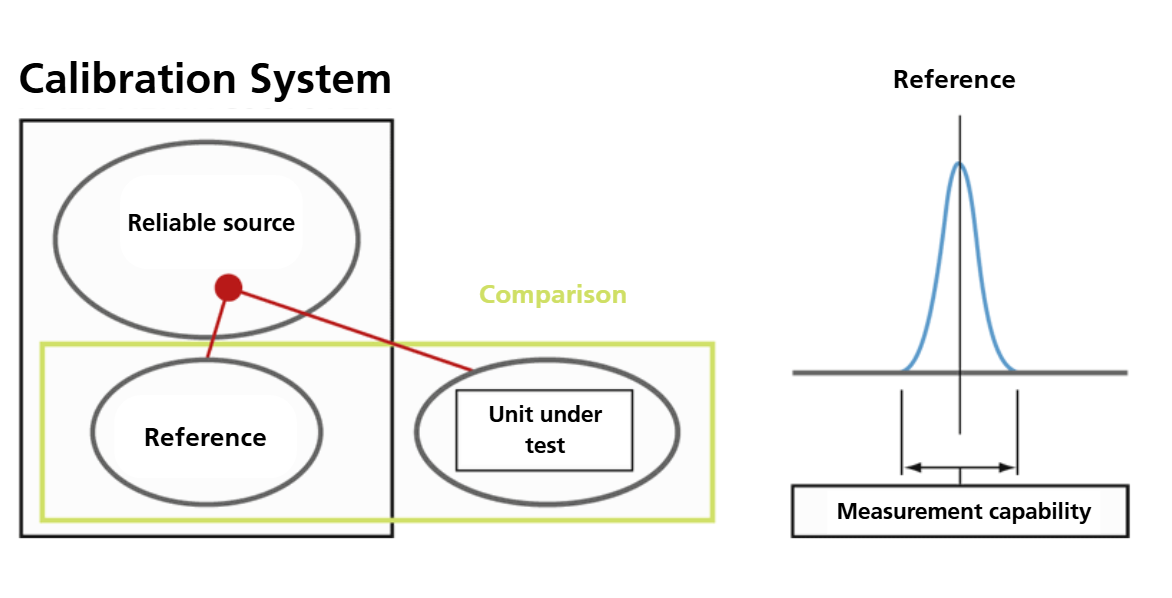
In simple terms, calibration is a comparison between a measured value and a reference value (see Figure 1). The idea of a “true value” is theoretical, because even a reference – for example a 1 kg mass standard – is defined with a stated measurement uncertainty. For this reason, calibration is inseparably linked to traceability.
Figure 1: Calibration system for comparative calibration
Traceability to a common, internationally defined reference value can be seen as a chain. Every link must remain intact to preserve confidence in the measurement. But traceability is not only about maintaining the chain and historical records – understanding how equipment performs over time is just as important if you want to use calibration results effectively.
Maintaining traceability and historical records is therefore essential, because it directly supports good calibration decisions. A sound approach is to calibrate the instrument, evaluate the results against established acceptance criteria, and then decide whether adjustment is required. If adjustment is needed, it is carried out and followed by a post-adjustment calibration.
When historical calibration results are used systematically, calibration costs can shift from being “just a necessary evil” to becoming a valuable investment.
If periodic calibration (for example annually) shows that an instrument regularly falls outside the acceptance criteria and needs frequent adjustment, it may indicate that the wrong instrument was selected, or that it is not stable enough for the application. In some cases, the instrument may have been out of tolerance for a full year. Depending on how directly it affects final product quality, this can have serious economic consequences. Possible responses include shortening the calibration interval to reduce risk, adjusting more frequently, or replacing the instrument where feasible.
Conversely, calibration may show that an instrument remains stable within the acceptance criteria year after year. Once this is documented over time, calibration intervals can be extended, reducing overall cost.
In summary:the cheapest instrument up front is not always the most cost-effective choice in the long run, once total cost is considered – including calibration, maintenance, and the impact on quality.
Isn’t a calibration just a calibration? After all, the main purpose is to establish and document traceability.
In practice, the choice between traceable and ISO/IEC 17025-accredited calibration depends on the industry and is often driven by customer, regulatory and market requirements. At the same time, tighter technical specifications for process and test equipment have increased the demands placed on calibration. As a result, the traditional rule of thumb – that the calibration system should be at least four times better than the unit under test – can be difficult to achieve in many modern applications.
For that reason, it is essential to understand the relevant uncertainty contributions and quantify the calibration uncertainty, in order to determine whether an instrument meets its defined acceptance criteria. Traceability is necessary, but it is only one part of the decision. Equally important is whether the selected calibration system has sufficient capability to reveal the instrument’s deviation rather than “masking” it through excessive reference uncertainty.
Example: Suppose you calibrate a 1 kg weight with a specification of ±10 g using a 1 kg reference weight that is traceable but has a tolerance of ±100 g. The calibration can be performed and the traceability chain is intact, but the result has no practical value. The reference uncertainty (or tolerance) is too large to verify whether the 1 kg test weight complies with its specification.
Measurement Capability
As mentioned earlier, the concept of a “true value” is an idealisation. Every calibration system introduces measurement uncertainty - whether it is as simple as comparing a 1 kg reference mass on a balance, or a more complex setup using digital instrumentation. The reference itself is characterised through calibration and has a stated uncertainty (typically significantly smaller than the specification of the unit under test). Further uncertainty contributions arise from the measurement system, the applied method, and environmental influences (see Figure 2).
Figure 2: Measurement capability describes the laboratory’s ability to perform measurements that are not materially influenced by the unit under test, expressed through the achievable measurement uncertainty over repeated measurements.
Calibration Result
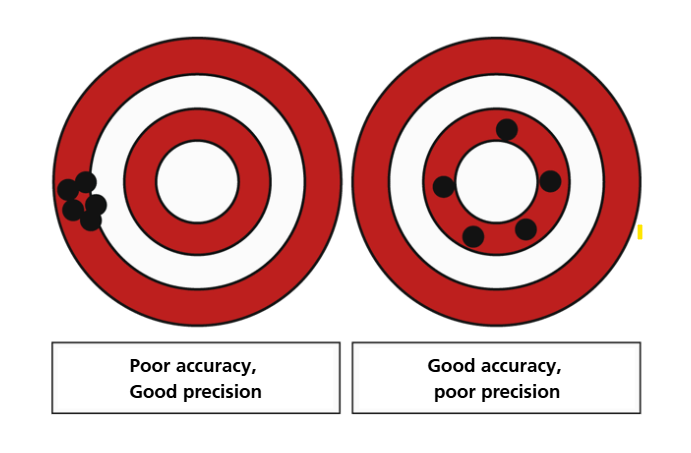
The result of a calibration is expressed as the deviation of the unit under test relative to the reference. In practice, this deviation is typically calculated as the mean of a series of repeated measurements (see Figure 3).
Figure 3: Left: poor accuracy but good precision (points are close together but far from the centre). Right: good accuracy but poor precision (points are close to the centre but far from each other).
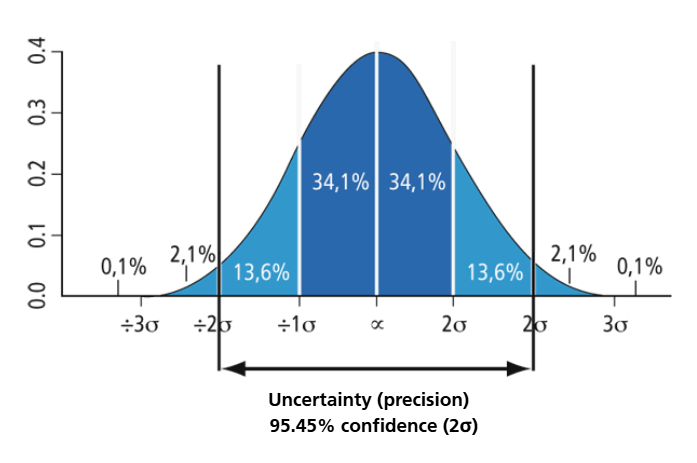
The measurement uncertainty of the calibration describes the range within which the true value of the measurand is believed to lie. It depends on several contributions, including the achieved precision (repeatability) from repeated measurements, the calibration system/laboratory measurement capability, the behaviour of the unit under test, the measurement method, and environmental influences. Measurement uncertainty is commonly reported as expanded uncertainty, obtained by multiplying the combined standard uncertainty by a coverage factor, typically k = 2 (±2σ), which corresponds to an approximate 95% level of confidence under normal assumptions (see Figure 4).
Figure 4:Normal distribution illustrating expanded uncertainty with k = 2 (±2σ), shown by the vertical lines.
Acceptance Criteria
A realistic acceptance criterion must take into account the instrument’s specifications, the repeatability of the calibration, the measurement capability of the calibration system/laboratory, the behaviour of the unit under test, and environmental influences.
If no acceptance criteria are defined, the instrument’s own specifications – accuracy and precision – are used by default. If the laboratory’s measurement capability is at least four times better than the unit under test, the laboratory contribution can normally be neglected. Otherwise, the overall evaluation must consider both the instrument’s specifications and the laboratory’s measurement capability.
This leads to a practical question: what is the difference between choosing traceable calibration and traceable accredited calibration?
Traceable Calibration
With traceable calibration, you obtain documented traceability to recognised standards, but not necessarily more than that. There may be no formal requirements for methods, equipment, environmental conditions, or personnel competence, and there is not always a stated overall precision for the calibration. In that sense, traceable calibration represents the lowest common denominator.
In practice, many traceable calibrations carried out under quality systems such as ISO 9001 still follow sound procedures, use suitable equipment, and are performed by qualified staff. For many applications, a traceable calibration is fully sufficient.
Typically includes:
Calibration performed with traceable equipment
Quality reference, e.g. ISO 9001
With traceable calibration, you get traceability but not necessarily much more. There may be no specific requirements for methods, equipment, or who can perform the calibration. There may also be no stated overall precision. This represents the “lowest common denominator.” Most ISO 9000 traceable calibrations still ensure proper procedures, appropriate equipment, and qualified personnel. A traceable calibration is often fully sufficient for the intended requirements.
Calibration performed with traceable equipment
Quality reference, e.g., ISO 9000
Accredited Calibration
Accredited calibration provides a stronger and more transparent basis for documentation. It ensures that methods, equipment, environmental conditions and execution are suitable for the task, and it includes a calculated and stated precision (measurement uncertainty) for each calibration.
An accredited laboratory is subject to independent oversight (e.g. DANAK), which regularly verifies that the laboratory maintains its measurement capability and delivers consistent results.
Typically includes:
Calibration performed according to defined measurement ranges and capability
Requirements for personnel competence, equipment capability and environmental control
Laboratory performance evaluated through audits and comparisons with other laboratories
Quality reference: ISO/IEC 17025
Accreditation body, e.g. DANAK, UKAS, NIST
Why Choose Accredited Calibration?
Accredited calibration should be selected whenever your application, customers or authorities require a high level of documented confidence. The certificate provides traceability confirmed by an independent third party (e.g. DANAK), reducing questions and the need for time-consuming supplier assessments. It also means you do not need to define and verify requirements for equipment, competence and documentation on your own – this is built into the accredited framework.
There are several reasons why calibration is important for your measuring equipment:
Increasing customer requirements
Process optimisation and outsourcing (maintaining competitiveness)
Compliance with production standards (regulatory requirements, environmental considerations, etc.)
Quality assurance (product consistency)
Process documentation
To meet these requirements, it is essential that your instruments are calibrated and documented in a systematic way. But calibration should not be carried out only because you are required to do so – it should also be done because it supports your processes and protects your business.
Is Calibration a Necessary Evil or a Good Investment?
Based on the points above, the answer is: both.
Calibration can feel like a necessary evil when requirements make it unavoidable. At the same time, it can be a sound investment. Reliable measurements help you avoid unnecessary raw material use, prevent quality deviations, and reduce the risk of costly errors.
Periodic calibration also gives you a practical basis for assessing whether your instruments are still the right choice for the task. Over time, this can lead to better decisions on calibration intervals, adjustments, or replacement - and ultimately deliver real operational and economic benefits.
Learn more about our new Insacal Conductivity Master Meter